Question 1: Find an article related to terrorism in two different newspapers, magazines, or blogs, preferably two with different styles and political leanings. Using at least two sources from this Conversation as references, analyze the use of language in the articles you selected.
I have chosen Fox News and The Onion for this question. Since the first is known to be very conservative and the latter is mainly liberal, it has a good contrast between political leanings and thus its language usage. The article on Fox News, called "ISIS foreign recruitment plummets as airstrikes destroy its cash supplies," is basically what the title says it is. It mentions how strict rules and planned attacks are helping to slowly defeat ISIS. The news website specifically uses the word ISIS and not terror in the title to avoid "the controversy over variants of the T-word" (Okrent 770). It also draws in readers as this organization has been getting a lot of media attention lately so people are interested to garner more information about them. This article goes on to support a Republican sponsored bill that "urge[s] the Department of Homeland Security to use testimonials from former or estranged jihads...to effectively counter the ISIS message" (Tomlinson). The author incorporates words like "hopeful," "eradicate," and "drop" to emphasize the success of their plans. She doesn't mention Democrats once so she is subtly arguing that Republicans are doing their best in this fight against terror while the Democrats are doing nothing.
Now onto The Onion. The article I chose on this website is called "U.S. to Fight Terror with Terror." The title and the content is satirizing the fact that the media in America puts more fear into the people than benefiting them in any way. It should be giving more tips and information to overcome terrorism but news outlets tend to report on only the damage groups such as ISIS have caused. Something else I noticed was the amount of times "terror" was used versus "terrorism." In previous years, people have "described the enemy as terrorism twice as often as terror" (Nunberg 768), but now "those proportions have been reversed" (Nunberg). This article also integrates "terror" more than the news report on Fox News which makes me believe The Onion is less sensitive towards this topic. Fox News doesn't want to offend any of its readers while The Onion is a well-known satire site. Therefore its subscribers will tend to get affected less. A similarity between these reports is that they both mention Republicans. However, The Onion makes fun of the Republicans' useless strategy to fight terror while Fox News praises them. The writer ridicules the Republicans as their logic consist of "it's a dog-eat-dog world" and "an eye for an eye."
It seems like both news sites are not politically correct. They do not strive for "a vision of a more just, inclusive society in which racism, sexism, and prejudice of all sorts have been erased" (Kakutani 762). Instead, they use more of a formal/polite speech in order to "convey a message and continue to negotiate [a] relationship" (Pinker 746). However, even if these news outlets are not politically correct, it should be acceptable as their job is to report the topic raw. It's just sometimes, the liberal and conservative bias is a bit too strong.
Sunday, May 1, 2016
Sunday, April 17, 2016
A Polite Persuasion
To the reader(s) who have a chance to take a look at this post, how are you? It's nice to meet you. We should get in touch! Just kidding, I wasn't saying this to actually get in touch with you, I'm just showing my politeness (heh). An anthropologist studying first-year students at a university in the United States states that friendly phrases like the one's above convey politeness rather than literal intent (sorry if I got your hopes up).
Anyways, I agree with this anthropologist as being polite has become an unspoken rule in our society today. It is necessary for people to use polite speech in order to achieve their goal. For example, if I wanted some extra credit in a certain 11 AP English class, I would probably have a higher chance of accomplishing this task by throwing in some courteous words or phrases rather than just bluntly asking for free points. Also, these considerate words show my respect towards the teacher and imply that I understand that they're the one in control. By politely requesting extra credit, I will be taken more seriously than just a teenager who demands points. Without this type of well-mannered word choice, my inquiry would have been disregarded and my grade ruined.
Furthermore, politeness is required for public speaking as well. People like politicians or businessmen utilize polite speech to give an impression that they're official and dignified. These individuals will avoid slang in order to portray their education. It also signifies that they are fit for a position to lead. Basically, polite language can lead to power and authority which makes it a great "language" for all people to incorporate in every day situations.
Sunday, March 27, 2016
Free 10 points yay
Funny quote of the week: "Everyone line up by color!" - Ms. Valentino 2k16
On a more serious note, let's talk about our education system. There's a reason America's education is only ranked 14th in the world. In fact, the highest Western nation on the list comes in 5th (Ranking America). The main problem is that our country fails to distribute the education funds equally to all socioeconomic groups. The gap between each social status is getting bigger and bigger, but the government does nothing about it. As Rebecca Strauss, an associate director of a CFR program, states that "wealthy students are achieving more, and the influence of parental wealth is stronger in the United States than anywhere else in the developed world." While the majority of developed countries invest more resources into lower-income school districts, the U.S. does the exact opposite. Here, most K-12 public schools are funded through local property taxes while the private schools are funded by rich upperclass families.
This chasm, however, does not stop at high schools; it continues to get larger in college. The gap in annual per-pupil spending between the most and least selective colleges is now nearly six times larger than 40 years ago. Even though it is becoming increasingly necessary to have a college education for success, fewer people are able to afford the hefty costs to essentially get a piece of paper. This results in a vicious never-ending cycle that will continue through generations. Since the poor parents will never have earned a college degree, they will not make enough money to send their kids to school, in turn causing their kid's kids to not get an adequate learning experience either. America's government needs to find a way to provide higher-quality education for all Americans, rich and poor, without expending the tight budget.
On a more serious note, let's talk about our education system. There's a reason America's education is only ranked 14th in the world. In fact, the highest Western nation on the list comes in 5th (Ranking America). The main problem is that our country fails to distribute the education funds equally to all socioeconomic groups. The gap between each social status is getting bigger and bigger, but the government does nothing about it. As Rebecca Strauss, an associate director of a CFR program, states that "wealthy students are achieving more, and the influence of parental wealth is stronger in the United States than anywhere else in the developed world." While the majority of developed countries invest more resources into lower-income school districts, the U.S. does the exact opposite. Here, most K-12 public schools are funded through local property taxes while the private schools are funded by rich upperclass families.
![]() |
| In STEM fields, the US is ranked 36th globally. |
Sunday, March 20, 2016
The Budget Brunch
In light of political campaigns going on right now, I have decided to talk about a political cartoon depicting the two different parties. This drawing has both of the animals saying, "Oh, you made this?" and then promptly dumping their "food" to portray how neither one likes what the other one has created. Obviously the elephant here represents the Republican Party and the donkey represents the Democratic Party. The cartoonist has also put a sign in the middle of the table saying "budget brunch" to emphasize that both parties dislike the other's budget plan just because it was produced by their own party. However, neither of them are discarding the wine on the table as they do have a focal point that both parties agree on: to cut spending.
The main message of this drawing is that Congress is at a deadlock when it comes to making a budget plan everyone is happy with. For example, the Democrats believe the "Republicans' reckless spending plan would cost jobs and make communities less safe" (Reid) while the Republicans state that the "Democrats put government budgets before family budgets" (Democrat vs Republican Budget). This point represents the huge chasm between the two parties in Congress and their dislike with one another. They might agree on some ideas but it's overlooked completely, like the wine glass, because they are from different parties. Therefore, the cartoon is bashing both sides of the political spectrum.
The artist is asserting the need for politicians to stop hating each other because of their political party names. If this trend continues, America will not maintain its status as the #1 superpower for long.
The main message of this drawing is that Congress is at a deadlock when it comes to making a budget plan everyone is happy with. For example, the Democrats believe the "Republicans' reckless spending plan would cost jobs and make communities less safe" (Reid) while the Republicans state that the "Democrats put government budgets before family budgets" (Democrat vs Republican Budget). This point represents the huge chasm between the two parties in Congress and their dislike with one another. They might agree on some ideas but it's overlooked completely, like the wine glass, because they are from different parties. Therefore, the cartoon is bashing both sides of the political spectrum.
The artist is asserting the need for politicians to stop hating each other because of their political party names. If this trend continues, America will not maintain its status as the #1 superpower for long.
Sunday, March 13, 2016
Restrain the World?!
Chet Raymo's piece, "A Measure of Restraint," provides tragic anecdotes where curiosity kills the cat (which in this case are a bunch of humans). He argues that "the unexamined quest for knowledge is hemmed with peril" which portrays his worry for the unrestrained advancement of science. Raymo doesn't want new scientific improvement without the necessary precautions and research to back it up. However, I strongly disagree with his stance on this topic.
To me, it seems like Raymo is too afraid of change. You need to take some leaps in order to discover something astounding. If past inventors or scientists had followed his point of view, then we wouldn't have things like electricity or airplanes. Benjamin Franklin and the Wright Brothers both took dangerous risks to advance the human race. Also, diseases and cancers would be ravaging the world because vaccines wouldn't be a thing. If it was up to Raymo, he probably would have declared that the cons outweigh the pros as the vaccines could do more harm than good. He would be too worried about having another incident like the discovery of radium.
I agree that we need some evidence for these projects but being overly careful isn't a good thing. By believing that "Beauty's nothing but the beginning of Terror" (Rilke) is way too pessimistic. Now, I'm not saying that we should suddenly build bigger nuclear bombs or weaponized robots. It's just that being excessively cautious would hold back the world's progress. Go big or go home, right?
To me, it seems like Raymo is too afraid of change. You need to take some leaps in order to discover something astounding. If past inventors or scientists had followed his point of view, then we wouldn't have things like electricity or airplanes. Benjamin Franklin and the Wright Brothers both took dangerous risks to advance the human race. Also, diseases and cancers would be ravaging the world because vaccines wouldn't be a thing. If it was up to Raymo, he probably would have declared that the cons outweigh the pros as the vaccines could do more harm than good. He would be too worried about having another incident like the discovery of radium.
I agree that we need some evidence for these projects but being overly careful isn't a good thing. By believing that "Beauty's nothing but the beginning of Terror" (Rilke) is way too pessimistic. Now, I'm not saying that we should suddenly build bigger nuclear bombs or weaponized robots. It's just that being excessively cautious would hold back the world's progress. Go big or go home, right?
Sunday, March 6, 2016
Videotape
The piece "Videotape" reminded me of Jeannette Walls' memoir, The Glass Castle. Just like how the Video Kid was a Lone Ranger by filming the shooting herself, Walls also did quirky things alone during her childhood. It seems like they fare do well at a casino; the Video Kid gambles if she will get a cool video or not and Walls gambles her life with fire. Okay, maybe that wasn't that great of a comparison, but my point is that both stories gave me new perspectives on life and on media profiling. The media profiles the girl in "Videotape" as Video Kid "because they have to call her something" (DeLillo). However, if the media had profiled Jeannette Walls, she would have been seen as an unfortunate child with bad parents. While others might say what I'm about to do is very childish, I don't care; this is my blog.
I'm going to parody the Pokemon theme song and title it "Videotape". (Sing this with the Pokemon tune and make Videotapes into 3 syllables, not 4:say vi-deo-tapes). Here's a link to the song if you forgot the tune: https://www.youtube.com/watch?v=pJ8heSeHX48
Videotapes
I wanna be the very best
Like no one ever was
To film things is my real test
To share them is my cause
I will travel across the land
Filming far and wide
Teaching kids to understand
The message that's inside
Videotapes (Gotta film 'em all), it's the camera and me
I know it's my destiny
(Videotapes!)
Ooh, they's my best friend
In a world we must defend
Videotapes (Gotta film 'em all), a heart so true
Our courage will pull us through
You watch them, and I'll teach you
Vi-deo-tapes!
(Gotta film 'em all!)
Gotta film 'em all!
Yeah...
Every challenge along the way
With courage I will face
I will film every day
To claim my rightful place
Watch with me, the time is right
There's no better team,
Camera in arm, we'll win the fight
It's always been my dream
Videotapes (Gotta film 'em all), it's the camera and me
I know it's my destiny
(Videotapes!)
Ooh, they're my best friend
In a world we must defend
Videotapes (Gotta film 'em all), a heart so true
Our courage will pull us through
You watch them, and I'll teach you
Vi-deo-tapes!
(Gotta film 'em all!)
Gotta film 'em all!
Gotta film 'em all!
Gotta film 'em all!
Gotta film 'em all!
Yeah!
Videotapes (Gotta film 'em all), it's the camera and me
I know it's my destiny
(Videotapes!)
Ooh, they're my best friend
In a world we must defend
Videotapes (Gotta film 'em all), a heart so true
Our courage will pull us through
You watch them, and I'll teach you
Vi-deo-tapes!
(Gotta film 'em all!)
Gotta film 'em all!
Videotapes!
Sunday, February 28, 2016
On the Want of Good Grades
DISCLAIMER: I wrote this after getting only 7 hours of sleep this since Friday (basically 7 hours of sleep during the past 65 hours). I hope this makes sense...
Anyways, literally and truly, one cannot get on well in the world without perfect grades. This is what I have been constantly told while growing up. However, after reading "On the Want of Money" by William Hazlitt, I realized a life set on an unhealthy goal is not a life worth living. Now I understand that even if I get good grades and become president of the world, I still might not get into the college of my choice. I can't be scared of failing as high school will become a place of "little credit or pleasure" (Hazlitt).
By junior year, everyone has the formula of good grades=good college=set future drilled into their minds. Grades are like bullies, they make you feel depressed and you end up beating yourself up for getting knocked down by them. Hazlitt's piece about how life becomes a blur is very relatable to high school. During the first week of first semester, I get extremely motivated to study and not procrastinate at all. I think I can "change" from my past habits so it's a very clear period of time. However, as the weeks progress, the year becomes muddy. This middle section goes by without much thought. To put it bluntly, I wake up, go to school, and go to sleep. This mundane schedule shows that "one cannot get much more mechanistic than that" (Didion). By accepting the need of a 4.0 is to "accept, consciously or unconsciously, a deeply mechanistic view of human behavior" (Didion). My actions become reciprocated so many times that I don't feel anything while doing them anymore. I don't get to experience high school to its fullest extent or even hang out with friends. The time between the first and last week of school can be seen as the worst, because I can rarely enjoy pure fun. Finally, at the end of second semester, my memories become clear again due to finals. I gain newfound ambition to give myself the decisive push to an A.Just like how Horace Miner satirizes the ridiculousness of American culture, I feel as though I am following the "body ritual among the [stneduts]" (aka students). I may believe that this is the best way to succeed, but to other people, it seems like "an example of the extremes to which human behavior can go" (Miner).
Sunday, February 21, 2016
Silly Bandz: An American Fad
As I was reading Jennifer Price's essay, my first thought was that Americans in the 1950's were weird. I mean who would buy a flamingo when there are so many other cool things out there? But then I realized that I don't have the right to judge these flamingo buyers because I've done the same thing before (not that I have bought fake flamingos but that I have bought into a trend before).
Silly Bandz. Ah these two words bring the feeling of nostalgia. I still remember trying to convince my mom 6 years ago to buy me all the different types of Silly Bandz. These rubber bands were so fun and colorful that all the kids wanted them in 2010. They came in many different themes such as sports, dinosaurs, rainforests, or cars. I think I still have some of them stashed away. Anyways, they were cheap and enjoyable to play with just like how the "sassy pink" (Price) flamingo was "the hottest color of the decade," (Price) showing "leisure and extravagance" (Price). The Silly Bandz parallel the unique popularity of the flamingos as they were once considered boring and mundane. I still can't believe how both of these items became popular just because they were different. The flamingo because it could be "tangerine, broiling magenta...methyl green" (Price) and the bands because of its cheap price and variety.
This is why American culture astounds me as anything can become popular overnight. On the other hand, these types of fads can also die within a few months, never to be seen again. I am very excited to see what else United States culture has in store for us.
Silly Bandz. Ah these two words bring the feeling of nostalgia. I still remember trying to convince my mom 6 years ago to buy me all the different types of Silly Bandz. These rubber bands were so fun and colorful that all the kids wanted them in 2010. They came in many different themes such as sports, dinosaurs, rainforests, or cars. I think I still have some of them stashed away. Anyways, they were cheap and enjoyable to play with just like how the "sassy pink" (Price) flamingo was "the hottest color of the decade," (Price) showing "leisure and extravagance" (Price). The Silly Bandz parallel the unique popularity of the flamingos as they were once considered boring and mundane. I still can't believe how both of these items became popular just because they were different. The flamingo because it could be "tangerine, broiling magenta...methyl green" (Price) and the bands because of its cheap price and variety.This is why American culture astounds me as anything can become popular overnight. On the other hand, these types of fads can also die within a few months, never to be seen again. I am very excited to see what else United States culture has in store for us.
Sunday, February 14, 2016
The Fault in Our Identity
The search for identity is a journey taken by everyone. The first major "identity crisis" usually takes place during high school-a place where students are trying to determine what they want to do in life. Many teenagers are insecure and scared about their future. They ask themselves, am I going to go to a good college? Am I going to be able to have a bright future? Is this worth it? Meena Alexander's piece, Fault Lines, is very relatable as I feel like high school students, like me, are going through the same issues she mentions in the essay.
Every day I worry about my grades and standardized test scores. My life is composed of waking up, going to school, eating some food, checking schoology, studying, and then going back to sleep. This cycle repeats, making my mundane life even more uneventful. Just like how Meena Alexander "caught [her] two eyes crooked, face disfigured," I see myself littered with flaws. Just like her, I've lived in different cities and countries since birth: Daegu, South Korea; Rochester Hills, Michigan; and now Troy, Michigan. Just like her, I ask myself "what of all the languages compacted in my brain" (Alexander): Korean, my parents tongue, the first language I ever learned; Chinese which I started to study as a middle schooler; and English-the one I picked up from ESL classes.
Daydreaming is also an unhealthy hobby of mine. I imagine scenarios where I become a famous doctor or rich engineer or even a talented athlete. However, I'm fearful that I will never amount to anything, that "everything I think of is filled with ghosts, even this longing" (Alexander). I sit here writing my 11 AP English blog at 11:39 on Valentine's Day, knowing that in a year, my future will be set. All that is left are the same questions that I cannot answer. Will I succeed? What could I ever be but a mere extra in this world? How am I going to discover my true identity in this chaotic society?
After finishing Alexander's work, I just sat down and thought about life. I realized I have two choices going forward: I could either be depressed about my shortcomings, or I could embrace my faults and enjoy life to the best of my ability. I wholeheartedly believe this path is better than slipping back to "the shelter of memory" (Alexander). I want to lead a life where I take charge instead of sitting in the back seat. I will not let my fractured identity hold me back; it will be used as an advantage instead.
Every day I worry about my grades and standardized test scores. My life is composed of waking up, going to school, eating some food, checking schoology, studying, and then going back to sleep. This cycle repeats, making my mundane life even more uneventful. Just like how Meena Alexander "caught [her] two eyes crooked, face disfigured," I see myself littered with flaws. Just like her, I've lived in different cities and countries since birth: Daegu, South Korea; Rochester Hills, Michigan; and now Troy, Michigan. Just like her, I ask myself "what of all the languages compacted in my brain" (Alexander): Korean, my parents tongue, the first language I ever learned; Chinese which I started to study as a middle schooler; and English-the one I picked up from ESL classes.
Daydreaming is also an unhealthy hobby of mine. I imagine scenarios where I become a famous doctor or rich engineer or even a talented athlete. However, I'm fearful that I will never amount to anything, that "everything I think of is filled with ghosts, even this longing" (Alexander). I sit here writing my 11 AP English blog at 11:39 on Valentine's Day, knowing that in a year, my future will be set. All that is left are the same questions that I cannot answer. Will I succeed? What could I ever be but a mere extra in this world? How am I going to discover my true identity in this chaotic society?
After finishing Alexander's work, I just sat down and thought about life. I realized I have two choices going forward: I could either be depressed about my shortcomings, or I could embrace my faults and enjoy life to the best of my ability. I wholeheartedly believe this path is better than slipping back to "the shelter of memory" (Alexander). I want to lead a life where I take charge instead of sitting in the back seat. I will not let my fractured identity hold me back; it will be used as an advantage instead.
Sunday, February 7, 2016
Ping Pong with my Father
These were the moments that led up to my eventual victory against my dad in a ping pong match.
I don't recall who suggested ping pong that day. We hadn't done it for a long time, for weeks. But there we were, across the table, face to face, extending our right arms holding our paddles. Our racquets were different. His resembled a worn out tree branch, one which had annihilated me with spinning shots countless times before. It was red and brown with some black dots scattered about. It looked sturdy, to be sure, though not so sturdy as it had in past years. I expect that back in his
youth it had looked even sturdier. In high school he had played ping pong and had been labeled as "best ping pong player" of the senior class. Between work hours he had worked on ping pong techniques and on ping pong drills. I admired him for that. I had begun to play in 8th grade and that accounted for some small wear and tear along the paddle, but it did not seem to be enough experience. The paddle I extended was relatively new and unused. Even so, he insisted that he would lose the match, that he was certain I'd win. I had to ignore this, however, because it was something he always said, whether or not he believed it himself.
I don't recall who suggested ping pong that day. We hadn't done it for a long time, for weeks. But there we were, across the table, face to face, extending our right arms holding our paddles. Our racquets were different. His resembled a worn out tree branch, one which had annihilated me with spinning shots countless times before. It was red and brown with some black dots scattered about. It looked sturdy, to be sure, though not so sturdy as it had in past years. I expect that back in his
youth it had looked even sturdier. In high school he had played ping pong and had been labeled as "best ping pong player" of the senior class. Between work hours he had worked on ping pong techniques and on ping pong drills. I admired him for that. I had begun to play in 8th grade and that accounted for some small wear and tear along the paddle, but it did not seem to be enough experience. The paddle I extended was relatively new and unused. Even so, he insisted that he would lose the match, that he was certain I'd win. I had to ignore this, however, because it was something he always said, whether or not he believed it himself.
Our warm hands shook once, much the same way we had high-fived the day after I aced my test. Fingers twisted and wrapped about the handle once again, testing for a better grip. Feet slid up and down making their little indentations on the flat carpet. My eyes narrowed in concentration as I tried to focus as much as possible on his position of the paddle and ball. Ping pong, I knew, was a competition that depended less on big movements than on one's reflexes and experience. I shifted my gaze toward his eyes and was ready. He looked back, smiled at me, and said softly (did he sound anxious?), "You say go."
It was not a long match; we only played up to 11 points. I had expected him to be more accurate, more agile. I was conditioned to lose and would have accepted defeat easily. However, after a few rallies, the ball yielded to my efforts and began to pass by his paddle a millisecond before it got there. I worked against the ball with all the strength I could find. He was working hard as well, sweating, breathing strained. It seemed that this time was different, that I was going to win. Then something occurred to me, something unexpected. I discovered that I was feeling sorry for my father. I wanted to win but I did not want to see him lose.
Sunday, January 31, 2016
Label Jars, NOT People
Since when did being disabled define a person? It seems as though society believes that having a disability is like carrying a huge sign that says I AM DISABLED, GIVE ME PITY. The disabled are not looking for a pity party where the public tells them everything is going to be all right or how help is right around the corner. I would be lying if I said I had never felt sympathy or judged these people. Even as I was typing that previous sentence, I felt like I was classifying them as a different species by describing them as "these people." Whenever I come across an impaired individual, I am always guilty for instantly having the reaction of feeling sorry for them.
After reading Disability by Nancy Mairs, I finally began to understand the point of view of disabled people. Since I have never had a disability, merely talking about is awkward and uncomfortable. However, Mairs writes with her "unsentimental candor" which gives new insight into the thoughts of the disabled. I never realized how the media rarely portrays the handicapped and even when they do, it usually ends with the cripple getting "[stripped] of even the urge toward independence" (Mairs 14). TV shows and movies "exclude the complexities that round out a [disabled] character" (14) and depict them as weak, dependent beings who need constant support and encouragement. These stereotypes of being sick or not being able to lead a productive life are the thoughts that cause an impaired person to feel "self-degradation and a subtle kind of self-alienation not unlike that experienced by other minorities" (14). This negative self-fulfilling prophecy is exactly what Nancy Mairs wants demolished. She desires for a society that integrates any type of person into "common scenes of our ordinary lives" (15).
At the end of the day, we are all regular people fighting to survive in the harsh reality called civilization. Disability is just a matter of perception, you can choose to accept it or be scared by it.
After reading Disability by Nancy Mairs, I finally began to understand the point of view of disabled people. Since I have never had a disability, merely talking about is awkward and uncomfortable. However, Mairs writes with her "unsentimental candor" which gives new insight into the thoughts of the disabled. I never realized how the media rarely portrays the handicapped and even when they do, it usually ends with the cripple getting "[stripped] of even the urge toward independence" (Mairs 14). TV shows and movies "exclude the complexities that round out a [disabled] character" (14) and depict them as weak, dependent beings who need constant support and encouragement. These stereotypes of being sick or not being able to lead a productive life are the thoughts that cause an impaired person to feel "self-degradation and a subtle kind of self-alienation not unlike that experienced by other minorities" (14). This negative self-fulfilling prophecy is exactly what Nancy Mairs wants demolished. She desires for a society that integrates any type of person into "common scenes of our ordinary lives" (15).
At the end of the day, we are all regular people fighting to survive in the harsh reality called civilization. Disability is just a matter of perception, you can choose to accept it or be scared by it.
Sunday, December 13, 2015
Wealth and Its Side Effects
People believe wealth will solve all of their problems. They think being rich will result in happiness. I used to have this same opinion myself but pieces like The Great Gatsby and "DBAR" have changed my mind. I realized that there were consequences that followed with owning an extreme amount of money. Things like greed and imprisonment could easily consume an individual and cause them to live an unfulfilling life such as Gatsby and Braddock Washington.
In The Great Gatsby, a man with everything one could want is reduced to watching a woman in between two bushes. Even though Gatsby has a house that's "a factual imitation of some Hôtel de Ville in Normandy" (Fitzgerald 7), his life is actually filled with emptiness. As the book progresses, the readers are introduced to Gatsby's unrequited love for Daisy and how he "stretched out" (24) for her. The extent of his fondness for her can be seen when he chooses to "wait all night if necessary" (154) between some bushes in front of her house. Also, he throws all of his lavish parties just to impress Daisy. Gatsby doesn't live life for himself but to impress a single person. He can't enjoy life until that person is in his possession, but since he will never achieve his dream, he will forever be a hollow individual void of enjoyment. It's ironic as wealth in this time period should allow a person to be free and do whatever they want but in his case, it imprisons him and keeps him from moving forward.
Washington can also be regarded as a rich white man who is confined to his wealth. His diamond that is "as big as the Ritz" (1) causes him to become greedy and store it all for himself. He spends his life guarding his diamond mountain by murdering all his guests and any pilots that attempt to scout his land. This ultimately leads to his demise as he has to blow up his "house of jewels" (25) and effectively killing his motivation to live, literally. Just like Gatsby, Braddock was restricted to keeping watch over his mountain of wealth. Both of their lives had no true meaning, and none of them lived life to the fullest. They died without really living at all.
In The Great Gatsby, a man with everything one could want is reduced to watching a woman in between two bushes. Even though Gatsby has a house that's "a factual imitation of some Hôtel de Ville in Normandy" (Fitzgerald 7), his life is actually filled with emptiness. As the book progresses, the readers are introduced to Gatsby's unrequited love for Daisy and how he "stretched out" (24) for her. The extent of his fondness for her can be seen when he chooses to "wait all night if necessary" (154) between some bushes in front of her house. Also, he throws all of his lavish parties just to impress Daisy. Gatsby doesn't live life for himself but to impress a single person. He can't enjoy life until that person is in his possession, but since he will never achieve his dream, he will forever be a hollow individual void of enjoyment. It's ironic as wealth in this time period should allow a person to be free and do whatever they want but in his case, it imprisons him and keeps him from moving forward.
Washington can also be regarded as a rich white man who is confined to his wealth. His diamond that is "as big as the Ritz" (1) causes him to become greedy and store it all for himself. He spends his life guarding his diamond mountain by murdering all his guests and any pilots that attempt to scout his land. This ultimately leads to his demise as he has to blow up his "house of jewels" (25) and effectively killing his motivation to live, literally. Just like Gatsby, Braddock was restricted to keeping watch over his mountain of wealth. Both of their lives had no true meaning, and none of them lived life to the fullest. They died without really living at all.
Sunday, December 6, 2015
The Unescapable Past
Up until this point in the book, Jay Gatsby's past has been nothing but rumors and gossip. The readers don't know what's true or false. Even though this isn't the turning point in the novel, I believe it's the turning point of how the audience sees him as a person. We can finally observe what influenced Gatsby to become the man he is today.
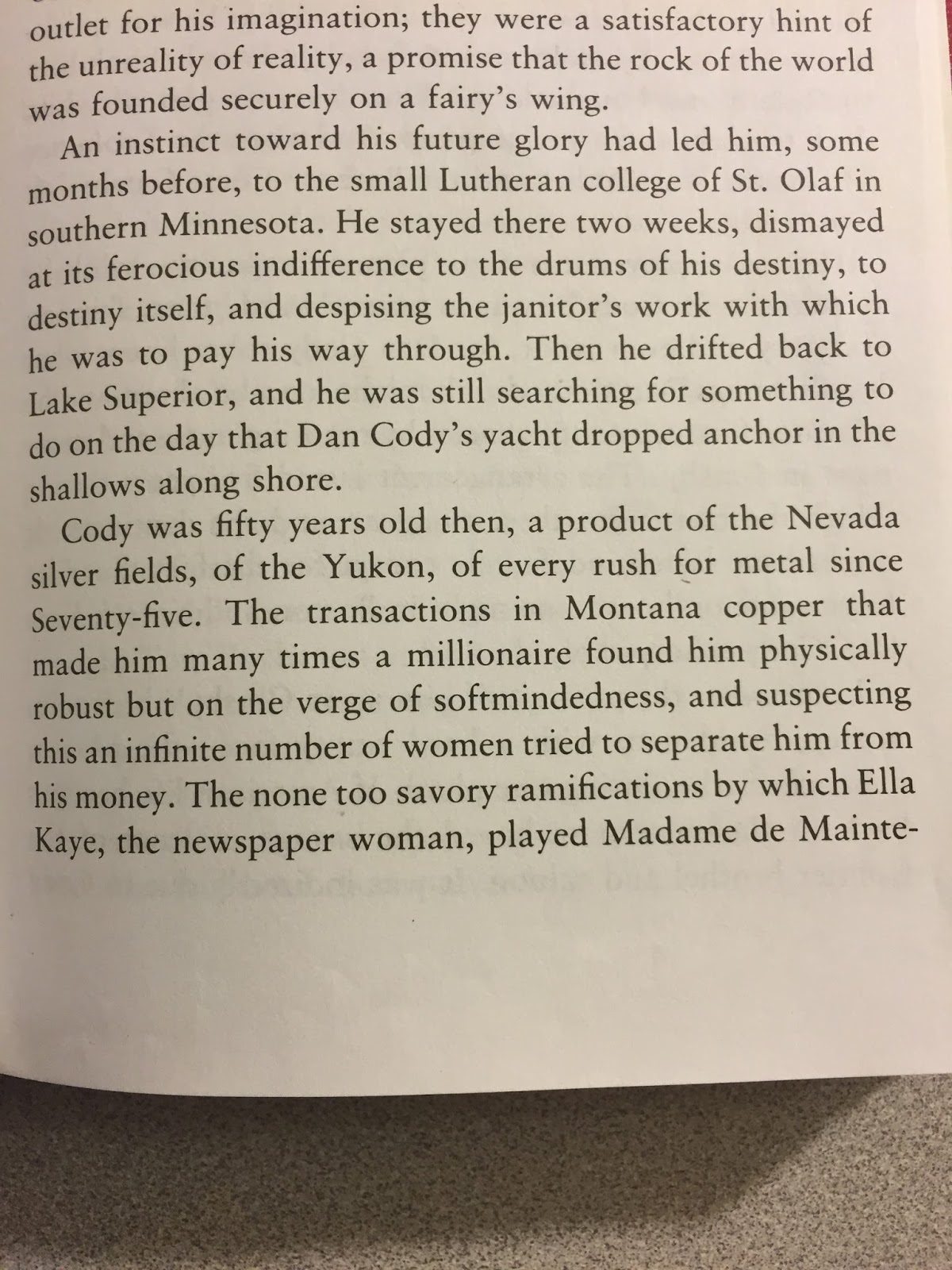
Jay Gatsby actually turns out to be a fake name he created in order to shake of his low social standing and to envision himself as a wealthy man. He rechristens himself from the name James Gatz in order to leave all his humiliation of his poor self behind. It's seems odd that the Gatsby in the present who throws lavish parties every night is the same person as the seventeen year old who had to do "janitor's work with which he was to pay his way through" (Fitzgerald 105) college. We also learn that Dan Cody is the epitome of what Gatsby wants to become. Dan is basically his "God" because after "he saw Dan Cody's yacht drop anchor over the most insidious flat on Lake Superior" (104), Gatsby began to avidly follow him. This moment in his life was essentially the chance he needed to achieve his dreams. The passage above emphasizes how social class was very important in this time period and how Gatsby's sensitivity towards status is his determination to succeed.


However as I read The Great Gatsby, I kept wondering why Gatsby allowed rumors like how "he killed a man once" (48) or how "he was a German spy during the war" (48) to circulate, because his status would surely have started to become damaged if people had start to believe these words. But after examining this part in the book, I feel like I have come to a conclusion: he let's those fake rumors spread and keep the citizens interested in order to hide his true past.
Sunday, November 29, 2015
The Underlying Truth
Nothing is perfect in this world. Nobody can be a "perfect" human being and no city can be classified as "perfect." Everyone and everything has an underlying flaw. It can be small or big, but it is always there. Take the students of Troy High as an example: Some may seem like happy go lucky kids on the outside, but in reality, many of them constantly worry about their grades and especially their future.


In The Great Gatsby by F. Scott Fitzgerald, Jay Gatsby is seen as a rich gentleman who has a marvelous mansion with "a marble swimming pool and more than forty acres of lawn and garden" (Fitzgerald 9). From this description of Gatsby's magnificent house, the readers can assume he has an easy life filled with relaxation and parties. However, when Nick Carraway first sees Gatsby, Nick notices that his neighbor "stretched out his arms toward the dark water in a curious way" (25). Nick quietly observes a minute green light far away which leaves the readers to conclude that Gatsby was stretching for this single light at the end of the dock. This illustrates how even though it seems Gatsby has all he could want, he reaches for that light which actually represents Daisy and how he strives to be like her. This perfectly imperfect man shows that no matter how much an individual has, he or she will always want more.
Nick also mentions the area between the West Egg and the East Egg. He meets Tom Buchanan's mistress in this "desolate area of land" (27). West and East Egg are both perceived as beautiful areas for the old and new rich. Even though this valley of ash is in between these two areas, the people who inhabit either Eggs are completely oblivious to this absolute desolation and poverty. This neglected space represents the moral decay hidden by the fanciful facades of the Eggs. It depicts how under all of the ornamentation and mannered charm lies the same ugliness that is in the valley. Just like how "an impenetrable cloud which screens their obscure operations from your sight" (27) in the valley, atrocious events are hidden by the glamor in the Eggs.


In The Great Gatsby by F. Scott Fitzgerald, Jay Gatsby is seen as a rich gentleman who has a marvelous mansion with "a marble swimming pool and more than forty acres of lawn and garden" (Fitzgerald 9). From this description of Gatsby's magnificent house, the readers can assume he has an easy life filled with relaxation and parties. However, when Nick Carraway first sees Gatsby, Nick notices that his neighbor "stretched out his arms toward the dark water in a curious way" (25). Nick quietly observes a minute green light far away which leaves the readers to conclude that Gatsby was stretching for this single light at the end of the dock. This illustrates how even though it seems Gatsby has all he could want, he reaches for that light which actually represents Daisy and how he strives to be like her. This perfectly imperfect man shows that no matter how much an individual has, he or she will always want more.
Nick also mentions the area between the West Egg and the East Egg. He meets Tom Buchanan's mistress in this "desolate area of land" (27). West and East Egg are both perceived as beautiful areas for the old and new rich. Even though this valley of ash is in between these two areas, the people who inhabit either Eggs are completely oblivious to this absolute desolation and poverty. This neglected space represents the moral decay hidden by the fanciful facades of the Eggs. It depicts how under all of the ornamentation and mannered charm lies the same ugliness that is in the valley. Just like how "an impenetrable cloud which screens their obscure operations from your sight" (27) in the valley, atrocious events are hidden by the glamor in the Eggs.
Sunday, November 22, 2015
Sacrificing Innocence
We all see childhood innocence as a beautiful thing. Children cannot grasp certain ideas like death and live in a world where Santa Claus and the tooth fairy exist. Even the word "innocence" itself sounds so pure. Maybe this is why parents try to hold on to their kids' innocence for so long. They attempt to shield them from violence and drugs while never having "the talk" with their children. As a result, overprotecting a child hinders their growth in the world. This leads me to question when does innocence become a bad thing? When is it essential for a child to lose their innocence?
When I finished reading MAUS, The Bluest Eye, and "The History Teacher," I noticed that all of them touch upon the topic of innocence in some way. In MAUS, Vladek's "mother killed herself (she left no note)" (Spiegelman) which devastates him and makes him feel extremely guilty. Even though the Holocaust slowly chips away at his innocence, the death of his mother impacts him the most. It meant that he is no longer has a caring mother at his side to help him get through tough times. Pecola Breedlove in The Bluest Eye literally loses her childhood innocence when Cholly, her own dad, rapes her. She had no idea what sex was or that incest is looked down upon so during the act, her blissful ignorance can be seen through "the rigidness of her shocked body, the silence of her stunned throat" (Morrison 162). Lastly, "The History Teacher" really emphasizes a teacher's effort to protect his kids from the tragedies in the past. He tells them "the Ice Age was really just the Chilly Age" and "the Enola Gay dropped one tiny atom on Japan" (Collins) which are huge understatements. The supposed history teacher makes the most important events in history seem very inconsequential. Even though the classroom became a very innocent place, "the children would leave his classroom for the playground to torment the weak and the smart"(Collins) which shows how the children are bullies who became destructive and ignorant because of the teacher's method of teaching.
MAUS and The Bluest Eye are examples that illustrate unnecessary loss of innocence. Vladek and Pecola were both going through extreme hardship but their purity had to become completely destroyed by unfortunate events. However, "The History Teacher" depicts unnecessary preservation of innocence. A history teacher has to teach true, unsugarcoated facts in order for the kids to learn the mistakes of the past. Here, it becomes imperative that the students lose some of their innocence in order to progress the world forward. I am left with one question that I can't seem to answer: Can you regain innocence?
When I finished reading MAUS, The Bluest Eye, and "The History Teacher," I noticed that all of them touch upon the topic of innocence in some way. In MAUS, Vladek's "mother killed herself (she left no note)" (Spiegelman) which devastates him and makes him feel extremely guilty. Even though the Holocaust slowly chips away at his innocence, the death of his mother impacts him the most. It meant that he is no longer has a caring mother at his side to help him get through tough times. Pecola Breedlove in The Bluest Eye literally loses her childhood innocence when Cholly, her own dad, rapes her. She had no idea what sex was or that incest is looked down upon so during the act, her blissful ignorance can be seen through "the rigidness of her shocked body, the silence of her stunned throat" (Morrison 162). Lastly, "The History Teacher" really emphasizes a teacher's effort to protect his kids from the tragedies in the past. He tells them "the Ice Age was really just the Chilly Age" and "the Enola Gay dropped one tiny atom on Japan" (Collins) which are huge understatements. The supposed history teacher makes the most important events in history seem very inconsequential. Even though the classroom became a very innocent place, "the children would leave his classroom for the playground to torment the weak and the smart"(Collins) which shows how the children are bullies who became destructive and ignorant because of the teacher's method of teaching.
MAUS and The Bluest Eye are examples that illustrate unnecessary loss of innocence. Vladek and Pecola were both going through extreme hardship but their purity had to become completely destroyed by unfortunate events. However, "The History Teacher" depicts unnecessary preservation of innocence. A history teacher has to teach true, unsugarcoated facts in order for the kids to learn the mistakes of the past. Here, it becomes imperative that the students lose some of their innocence in order to progress the world forward. I am left with one question that I can't seem to answer: Can you regain innocence?
Sunday, November 15, 2015
The Media
The Media rarely gives a fair representation of the world. It hides certain things that wouldn't please governments and only presents issues in allied countries. For example, on November 13, 2015, there was a terrorist attack on Paris, France. However, the events of the earthquake in Japan, bombings in Beirut, and the landslide in China aren't being emphasized. All the news outlets bombard its audience with more news on Paris while all the other deaths are being glanced over. The majority of the citizens have no idea any of this ever happened.
In The Bluest Eye by Toni Morrison, Pauline gets obsessed with white beauty because of the Media's bias towards white beauty standards. She starts to go to the movies in order to escape her black reality, and it causes her to subconsciously judge a face into "some category in the scale of absolute beauty" (122) that she absorbed from the screen. This is just like how the Media today discriminates Muslims as terrorists and as people who cannot be tolerated. As a result, many individuals automatically assume that Muslims are dangerous and shouldn't be treated with respect. The movies also force Pauline to believe that being white and having a white family is the way to live. She knows that she can't reach this standard but she allows it to consume her thoughts and appearance. She desperately tries to look like "white" by copying Jean Harlow and fixes her "hair up like [she'd] seen hers on a magazine" (123). Nevertheless when her tooth falls out, her only chance of happiness gets utterly crushed. This leaves me to wonder if the movies had illustrated that everyone is beautiful for Pauline, would she have been happy with her life? Or if she had never even gone to the movies, could she have lived a happier life?
![]() |
| Beirut Bombing |
![]() |
| China Landslide |
Sunday, November 8, 2015
It's All About Perspective
People have many different perspectives on life. Some people are pessimists, while some are optimists. They have a choice to either have a negative outlook on life or a positive one. This choice determines if that individual will be happy or sad, loud or quiet, energetic or reserved, etc. However, some people, such as minorities, are not given this simple choice. They are raised in a world where society oppresses them. Society forces them to believe that they are lower than human-status. It causes these individuals to accept that the way people observe them are more real than what they themselves observe.
Pecola Breedlove in the novel The Bluest Eye by Toni Morrison, is portrayed as a weak, American American girl who wants blue eyes in order to change what she sees and to change how others see her. She has a very negative outlook on life as she always concludes that how people see her ugliness creates the hurtful behavior that she notices and experiences. For example, when Pecola goes to buy Mary Jane candies, she thinks the cashier's "distaste must be for her, her blackness" (49). She has encountered so many unforgiving glares of white people that she automatically assumes she is the problem. Her daily rejections from society emphasizes that ugliness is inherent and nothing can change even by peering at the world differently. Despite her attitude, I believe she can change her gloomy perspective. When Pecola wonders "why...do people call them weeds" (Morrison 47), she is trying not to conform to society's opinion on dandelions. "She thought they were pretty" (47)
which illustrates how Pecola isn't mature enough yet to realize that beauty can be created by seeing rather than being seen. However, this little moment of freedom and individualism shows how with a little help, she can eventually grow into a strong and confident African American woman.
Sunday, November 1, 2015
Monuments
People travel to see monuments and statues all over the world. For example, 6 million people annually come to the United States to take a look at the Lincoln Memorial. Why do so many tourists come to see it even though "it sits literally on mud dredged from the Potomac River bottom in the late nineteenth century" (Savage)? The Lincoln Memorial "did not even exist in Lincoln's lifetime" (Savage), so why is it such a remarkable piece of art? Even though the memorial contains no actual artifacts of Lincoln, the monument manufactures its own aura and fulfills "the deep need for attachment that can be met only in a real place" (Savage).
Monuments and memorials become so much more meaningful when an individual is standing in front of it rather than looking at a Google image. A great example would be the monument of Christopher Columbus in Riverside Park, Easton, Pennsylvania. If a person were to just look at a photo of the statue, it would look like any other statue. However, if they were to visit the park and experience the statue and the environment around it, they would get the full experience. On a foggy day, a person would be able to feel the solemn atmosphere around the statue which represents how Columbus felt while observing the immense amount of land in North America. Also, the person would notice how the creator put the majestic statue in the middle of a park and not in a graveyard to allow the statue to have daily interactions with the people every day. There are countless numbers of monuments like this from The Maine Lobsterman to Crazy Horse to the Holocaust Museum that illustrate the fact that monuments need to be seen in person. All of these memorials carefully consider the location, size, materials, and purpose in order to pay respect to deep sacrifice or honor remarkable achievements.
Sunday, October 25, 2015
Morality and Ethics
Morality is the "principle concerning the distinction between right and wrong or good and bad behavior" (Google) while ethics is "the branch of philosophy that involves systematizing, defending, and recommending concepts of right and wrong conduct" (Google). Both words mean to distinguish between what is right and what is wrong. It seems easy to decide what is right and what is wrong as we do it every day. However, when the Jews get thrown into the Holocaust, identifying between good and bad becomes the choice between life and death.
In Maus, the recurring theme of morality and ethics emphasizes how emotional strain will inevitably affect the decisions of humans. First of all, the Nazis reduce the Jews to sub-human status such as pests like mice in order to degrade the Jews even further. This shows that the Nazis did not believe the Jews were people worth of ethical consideration. They believed that Jews weren't even capable of differentiating what's a good and what's bad. The Holocaust also creates multiple situations that illustrate the strain of morality and ethics in desperate times. Everything that holds humans together, like friends, family, and community, crumbles. During this time, "it wasn't anymore families. It was everybody to take care for himself!" (Spiegelman 114). Vladek emphasizes this to Art so he realizes that Jews were put in impossible circumstances where people had to throw away their morals to live. For example, the Jews had to start stealing food because it became so scarce. Some Jews ratted out others in hopes they would survive. Whole families were torn apart and friendships were irreversibly damaged. The ones that remained after the Holocaust would forever have to live with the guilt and regret of their selfish behavior.
Sunday, October 18, 2015
The Inevitable Doom
Death is a topic that is often avoided. People become uncomfortable when the word "death" is brought up. Everyone knows that they will have to face death one way or another but they are all scared to do so. Few embrace death and live their remaining moments to the fullest but the majority is imprisoned by the fear of an abrupt end. During the Holocaust, the Jews always struggled with life and death. They couldn't rest for one moment without being forever conscious of Nazis right around the corner. However, many Jews were fated for death because no matter how hard they tried to escape, the Nazis cornered and murdered them.
In MAUS, the Jews are represented by mice. They are constantly running from the Nazis who are depicted as cats. Once the Jews realized they were being hunted, they attempted to run away from the Nazis. However, it was all in vain as the Nazis eventually found them and killed them. On this page, Vladek and Anja get captured by the Nazis and get taken to Auschwitz. This is the first time the Nazi symbol is completely visible without anything covering it. It represents how the Nazis have finally rose to complete power and nothing will stop them from killing all of the Jews. It also illustrates that they've finally achieved their true form and have the means to murder millions of more people. In the top panel, the truck's cargo area is striped to serve as prison bars. It shows how even from the transport, the Jews will start to feel their imprisonment and how helpless they really are. The next few panels show how the Jews in the background are shaded in black. This means that they will all meet their death at the concentration camp. Vladek and Anja are shaded in white as they will come out of Auschwitz alive unlike most of the Jews. Finally, the last part of the page is not in boxes. This could mean that this part of Vladek's life was so traumatic that it is not confined to the past. It leaks into the present and the future and haunts him for the rest of his life. The picture doesn't even leave room for the page number. It suggests that time becomes irrelevant and unrecordable as the days before the deaths seem endless and dragged on. For the Jews, the minutes and hours become a mush of numbers as they trudge through the day. In addition, the sign above the truck is covered in ice which radiate a deadly atmosphere. It portrays the cold environment waiting for anyone who enters the camp.
Ultimately, Vladek and Anja were captured even after multiple attempts to hide from the Nazis just like many other Jews. I believe that they survived because they had a will to live and get reunited which leads into my final thoughts: How did they survive over the millions of other Jews that died? Was it Vladek and Anja's will to live that saved them or was it fate that spared them from their inevitable demise?
In MAUS, the Jews are represented by mice. They are constantly running from the Nazis who are depicted as cats. Once the Jews realized they were being hunted, they attempted to run away from the Nazis. However, it was all in vain as the Nazis eventually found them and killed them. On this page, Vladek and Anja get captured by the Nazis and get taken to Auschwitz. This is the first time the Nazi symbol is completely visible without anything covering it. It represents how the Nazis have finally rose to complete power and nothing will stop them from killing all of the Jews. It also illustrates that they've finally achieved their true form and have the means to murder millions of more people. In the top panel, the truck's cargo area is striped to serve as prison bars. It shows how even from the transport, the Jews will start to feel their imprisonment and how helpless they really are. The next few panels show how the Jews in the background are shaded in black. This means that they will all meet their death at the concentration camp. Vladek and Anja are shaded in white as they will come out of Auschwitz alive unlike most of the Jews. Finally, the last part of the page is not in boxes. This could mean that this part of Vladek's life was so traumatic that it is not confined to the past. It leaks into the present and the future and haunts him for the rest of his life. The picture doesn't even leave room for the page number. It suggests that time becomes irrelevant and unrecordable as the days before the deaths seem endless and dragged on. For the Jews, the minutes and hours become a mush of numbers as they trudge through the day. In addition, the sign above the truck is covered in ice which radiate a deadly atmosphere. It portrays the cold environment waiting for anyone who enters the camp.
Ultimately, Vladek and Anja were captured even after multiple attempts to hide from the Nazis just like many other Jews. I believe that they survived because they had a will to live and get reunited which leads into my final thoughts: How did they survive over the millions of other Jews that died? Was it Vladek and Anja's will to live that saved them or was it fate that spared them from their inevitable demise?
Subscribe to:
Posts (Atom)